
Technology
Tokuyama Dental’s products are built on our proprietary core technologies.
Explore the results of our research and development in areas such as filler design, polymerization technology, and structural color.
Supra-Nano Spherical Filler
A uniform filler of the ideal size for both strength and esthetics

The final finish is determined by the filler
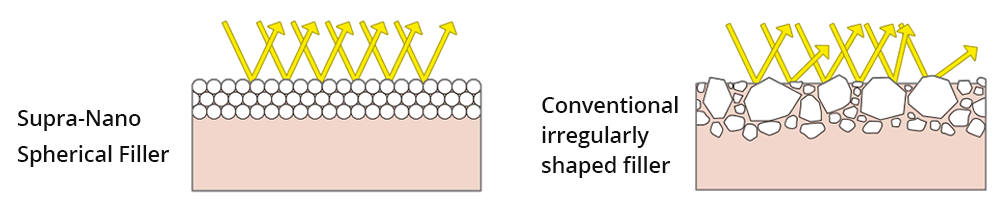
Issues in composite resin restorations—time required for polishing, cloudy finishes, and luster that fades within a few years—stem from the shape and size of the filler particles. Standard fillers are made from crushed quartz or glass, meaning particle size and shape tend to be irregular.
The solution: uniform particles
Supra-Nano Spherical Filler is synthesized using a proprietary sol-gel method in which particles are grown through the dehydration condensation reaction of metal alkoxides. Controlling the process at the molecular level creates nano-sized spherical filler particles.
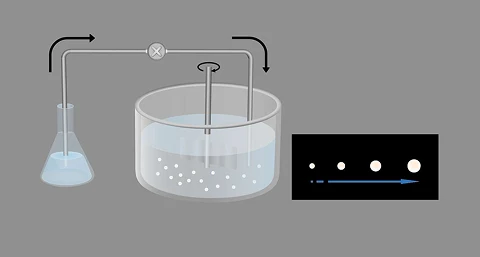
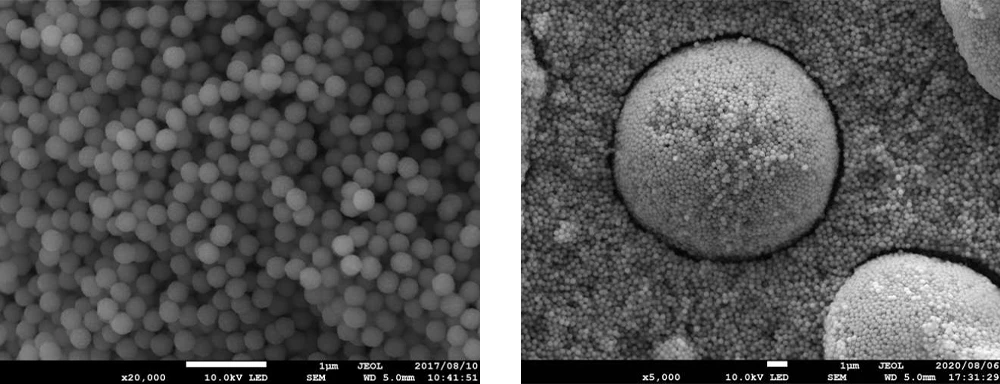
Through this innovative process, Tokuyama Dental has successfully developed a proprietary, ultra-fine spherical filler composed of silicon dioxide (SiO₂) and zirconium dioxide (ZrO₂). Unlike conventional manufacturing methods, the sol-gel method can control particle size and shape with extremely high precision, making it possible to produce a nearly perfectly uniform spherical filler.
Blending this precisely sized, evenly shaped filler at a consistent high density creates smoother surfaces and better polishability. It also gives restorations a shine and translucency similar to natural teeth. All of Tokuyama Dental’s composite resin products use this Supra-Nano Spherical Filler.
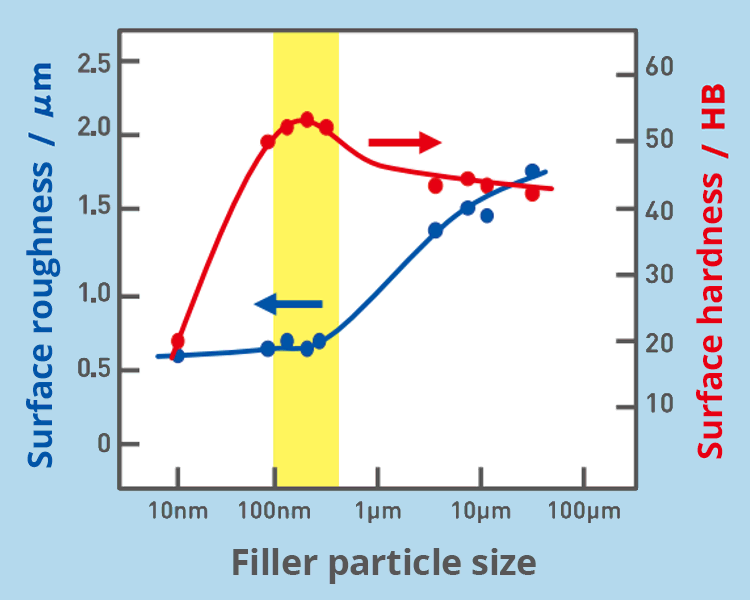
The ideal size for both smoothness and strength
Through this innovative process, Tokuyama Dental has successfully developed a proprietary, ultra-fine spherical filler composed of silicon dioxide (SiO₂) and zirconium dioxide (ZrO₂). Unlike conventional manufacturing methods, the sol-gel method can control particle size and shape with extremely high precision, making it possible to produce a nearly perfectly uniform spherical filler.
Blending this precisely sized, evenly shaped filler at a consistent high density creates smoother surfaces and better polishability. It also gives restorations a shine and translucency similar to natural teeth. All of Tokuyama Dental’s composite resin products use this Supra-Nano Spherical Filler.
Products using this technology (all composite resin products)
Smart Chromatic Technology
More beautiful, more natural—overturning conventions in dental materials
Solving challenges in shade selection
Dentists once had to select a composite resin from as many as 40 shades, making the process time-consuming and prone to shade mismatches. OMNICHROMA, a product built on Smart Chromatic Technology, uses proprietary filler technology to achieve a natural match for the patient’s original tooth color with just one shade.
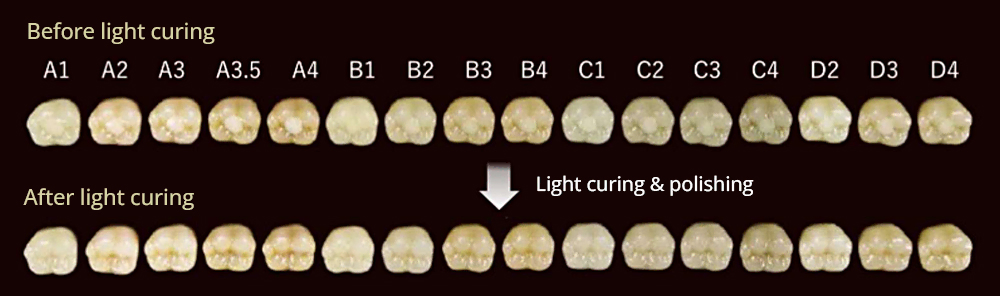
Structural coloration as the key
Structural coloration is not the color of an object itself, but the color produced by microscopic surface structures fine enough to cause light scattering and interference, thus emphasizing specific wavelengths. This differs fundamentally from pigment-based coloration. The wings of a Morpho butterfly, for instance, are in fact dark gray, but their ridged structure reflects and intensifies blue wavelengths when illuminated, making them appear a vivid blue. By focusing on this principle and precisely controlling the particle diameter of spherical fillers, we discovered a composite resin that produces structural color without pigments.
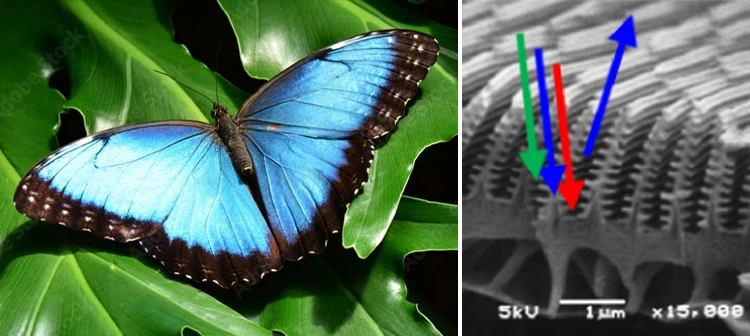
(Photo from The Science of Color; reproduced with partial modification, with permission from Ryuzo Hasegawa, science museum curator, and Dr. Shinya Yoshioka, Tokyo University of Science)
Mechanisms for tooth color matching
Thanks to its uniform particle diameter and perfectly spherical shape, Supra-Nano Spherical Filler reflects and transmits light to match the shade of the surrounding tooth structure. This means a single paste achieves shade-free matching for a wide range of tooth colors.
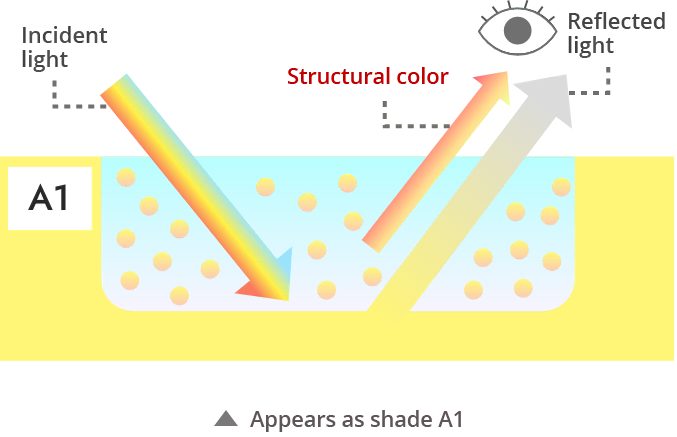
Products using this technology
RAP Technology (Radical-Amplified Photopolymerization initiator)
Shorter treatment times for more efficient care
For shorter treatment times
Composite resin hardens when exposed to light and sets in place in the affected area of the tooth. In this process, the light-responsive polymerization initiator camphorquinone is activated, generating radicals that trigger the curing reaction. Conventionally, this process involved the conflicting challenges below, resulting in longer treatment times:
- Higher camphorquinone levels react more easily to ambient dental office lighting
- On the other hand, only a limited amount of radicals are generated, resulting in longer curing times
Fast curing with less light
RAP Technology was developed to solve this challenge. Incorporating a radical amplifier generates a high quantity of radicals with just a small amount of camphorquinone, efficiently accelerating the curing reaction during light curing. Meanwhile, it is designed to be less reactive to ambient light in the treatment room, ensuring sufficient working time.
As a result, RAP Technology reduces light curing time to about one-third of what was conventionally needed while minimizing the influence of dental office lighting. This technology is compatible with a variety of curing lights, including LED, halogen, and xenon, making it possible to efficiently perform procedures such as treating severe caries or placing multilayer fillings, where shorter treatment times are desirable.
Products using this technology (all composite resin products)
BoSE Technology × Contact Cure (Borate Self-Cure)
Stable bonding strength without light curing


Reliable bonding even where light doesn’t reach
Bonding composite resin generally relies on light curing, meaning that stable bonding can be difficult in areas hard for light to reach or in complex cases. BoSE Technology is a bonding technology that cures through a chemical reaction (self-polymerization) without the use of light. It delivers stable bonding strength on par with light polymerization, enabling reliable adhesion regardless of the circumstances of treatment.
Stable reactions made possible by a two-liquid system
BoSE Technology divides the components containing the silane coupling agent into two separate bottles. The reaction only starts once the two liquids are mixed immediately before use, allowing the bonding procedure to be performed with consistent high reactivity. In some bonding agents, the coupling agent is pre-mixed, which can lead to a reaction occurring over time that renders it difficult for the agent to achieve its full effectiveness by the time it is actually used. A key advantage of this two-liquid system is that the reaction is triggered only when needed.
Contact Cure: Reliable polymerization from the bonding interface
Contact Cure is a technology that encourages the polymerization reaction at the interface where the polymerizable resin and bonding agent come into contact. This promotes polymerization at the bonding interface regardless of curing method, reducing the risk of bonding failure. Combining these two technologies allows polymerization to proceed reliably from the interface between the bonding agent and resin material, enabling stable bonding regardless of light exposure or material type.
Products using this technology
